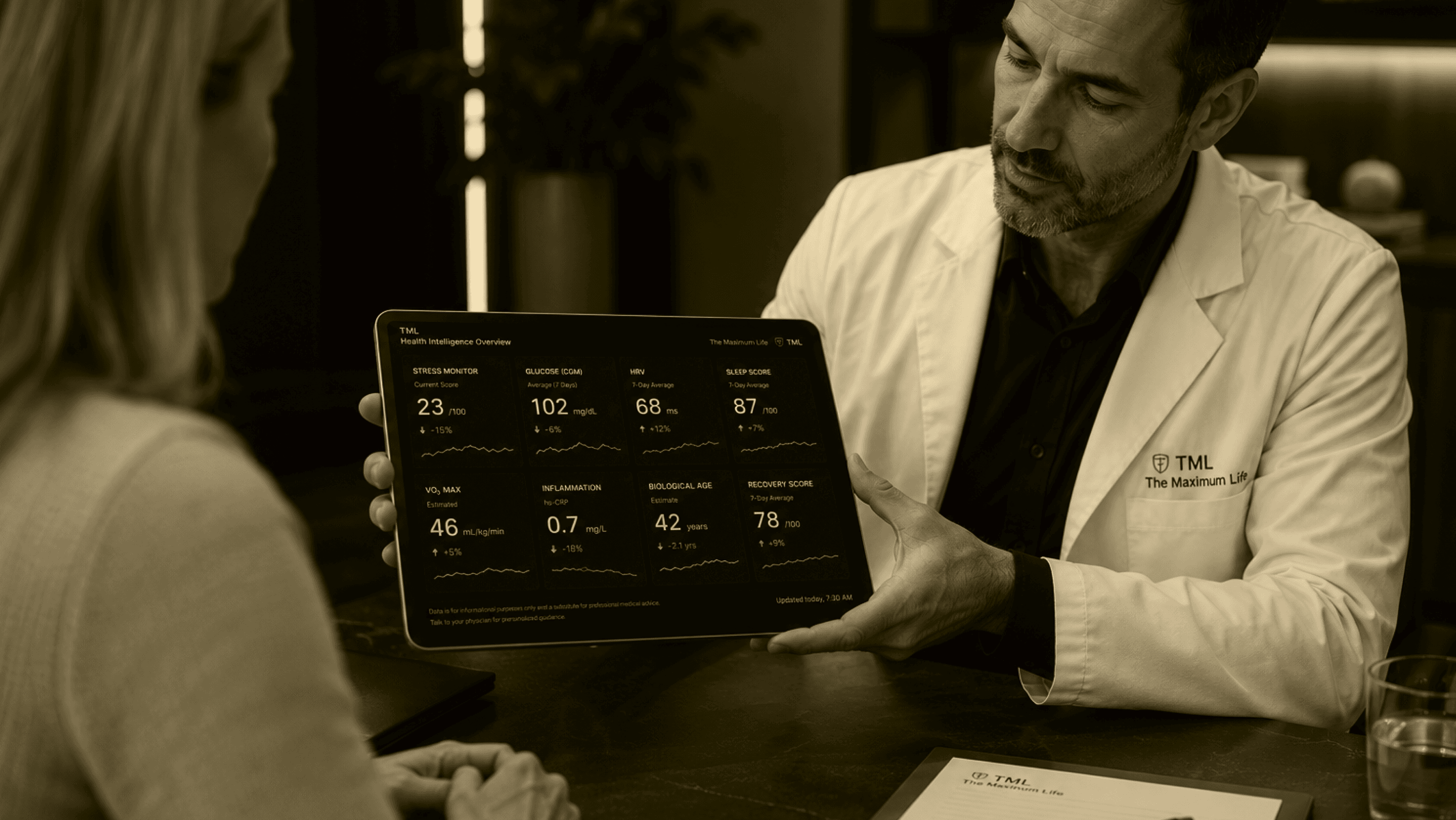
Most people are used to a version of healthcare that activates only after something goes wrong. Symptoms appear, a lab value crosses a threshold, a diagnosis is made, and treatment begins. That model can be lifesaving when disease is already present, but it is not the same thing as understanding health early enough to shape its direction. This is where health intelligence becomes important. Health intelligence is the process of turning scattered health data into meaningful clinical insight. It is not collecting more numbers; it is understanding what those numbers mean together, how they change over time, and which of them deserve to influence care. It is also the foundation of the physician-led longevity model this series is built around. In a world of wearables, advanced labs, and home testing, the challenge is no longer getting information. The challenge is deciding what matters.
From Data to Intelligence
A person can have dozens of biomarkers, multiple devices, and years of lab work, and still have no real clarity about whether their health is improving, drifting, or at risk. One marker is slightly elevated, another looks normal, and a wearable disagrees with how they actually feel. Without structure, the member is left with fragments. Health intelligence is what happens when those fragments are organized into a coherent picture — a picture that is different for every person.
Personalization: Health Intelligence Applied to One Person
In the first article of this series, we made a claim worth unpacking: personalization is not using someone’s name in an app or adjusting a supplement list. It is health intelligence applied to one person. What does that mean in practice? People do not age in identical ways, so the same number can carry two different meanings. Two people may both have mildly elevated fasting glucose. For one — active, lean, metabolically healthy — it is an isolated fluctuation. For the other, it is the earliest visible edge of a pattern: rising visceral fat, poor sleep, worsening insulin dynamics. The number alone does not tell the story. The context does. Health intelligence is the discipline of reading that context, and it changes the questions care is built on: not “Is this lab normal?” but “What pattern is emerging, and does it change decisions?”
Prevention Depends on Seeing Patterns Early
Preventive medicine is not ordering more tests or screening earlier. It is identifying meaningful change before it becomes fixed disease — seeing the shift before the breakdown. This is where continuous health monitoring earns its place, when used thoughtfully: a single office blood pressure may look fine while the trend drifts steadily upward. Trends reveal what snapshots miss, early enough for intervention to matter more.
“Knowledge, in this case, isn’t just power, it’s prevention.” — Frank Lipman, MD, “Meet Your Exposome,” drfranklipman.com But a trend is only knowledge when someone is responsible for reading it.
Why It Must Be Physician-Led
More tracking is not automatically better care. Unstructured tracking can create anxiety, obsession, or false reassurance. Health intelligence is not self-surveillance; it is a small set of signals, selected because they can change decisions, read by a physician who also knows the person’s history, behavior, family risk, and goals. That clinical judgment — what deserves action, what deserves watching, what deserves nothing at all — is the subject of Why Physician-Led Interpretation Matters.
Making Health Legible
There is also a human side. People change behavior more readily when they can see why it matters — when poor sleep stops being an abstract vice and becomes the visible driver of their rising fasting insulin. Health intelligence turns generic advice into a personal, legible story. Motivation follows meaning. Legibility also compounds. When someone watches their own data respond — recovery improving as training becomes consistent, glucose variability settling as meals change — the feedback loop replaces willpower with evidence. Progress stops being a vague feeling and becomes visible: real numbers, from their own body, moving in the right direction. That visible improvement is itself the motivation, and making it visible is part of what health intelligence is for. Health stops being a set of instructions handed down at an appointment and becomes a story the person can read, and to some extent write, for themselves. That shared language between physician and member is what keeps a long-term plan alive between visits, and it is where digital support earns its place in the model.
What This Does Not Mean
Health intelligence does not mean that one test can define your health, that a wearable score can diagnose anything, or that more tracking is always better. No single metric captures the whole person, predicts the future, or replaces clinical judgment. It means the right data, chosen and read in context, can guide better decisions over time.
The TML Lens
At The Maximum Life, health intelligence means selecting the few signals that can actually change decisions, then reading them against the member’s physiology, goals, and long-term care plan. It is not about data volume. It is about clinically meaningful clarity — giving physician-led care a more precise map. Explore the TML member journey
The Bottom Line
Health intelligence is not having more health data. It is knowing which signals matter, how they fit together, and what they suggest about where your health is heading — so decisions can be made earlier, and made for you specifically. Health intelligence is one pillar of a larger model — the full picture is in Physician-Led Longevity and the Rise of Health Intelligence. To see how it is applied over time, continue with Why Continuity Matters in Longevity Care and How Digital Support Helps Longevity Care Continue Between Visits.
References
- Topol EJ. High-performance medicine: the convergence of human and artificial intelligence. Nat Med. 2019.
- Hood L, Friend SH. Predictive, personalized, preventive, participatory medicine. Nat Rev Clin Oncol. 2011.
- Ashley EA. Towards precision medicine. Nat Rev Genet. 2016.