At a glance
- Stress is a physiological signal, not a personal failure.
- The nervous system shifts between activation and recovery throughout the day.
- The vagus nerve helps coordinate the parasympathetic “rest, digest, and repair” response.
- Slow breathing, meditation, NSDR, restorative movement, connection, and sleep can support regulation.
- Rest is not only physical. Mental, emotional, social, sensory, creative, and spiritual rest matter too.
- Supportive practices can help build resilience, but they are not a substitute for medical or mental health care when needed.
The bottom line
A well-regulated life is not a stress-free life.
It is a life with enough recovery built in that the body can return to balance after challenge. The goal is flexibility: the capacity to rise when needed, settle when safe, sleep deeply, digest well, think clearly, and connect honestly.
Stress becomes more costly when it is constant, unprocessed, and unsupported by rest.
Stress is not just in your head
When people say they are stressed, they usually mean they feel overwhelmed, tense, anxious, irritable, or exhausted. Beneath those feelings is a coordinated biological response.
The stress response can involve faster breathing, increased heart rate, higher muscle tension, altered digestion, shifts in cortisol and adrenaline, changes in blood sugar availability, and lighter sleep.
In the short term, this can be adaptive. It helps us respond to pressure and meet demands. The problem is not stress itself. The problem is stress without recovery.
Over time, persistent stress may contribute to patterns linked with accelerated aging: poor sleep, insulin resistance, inflammation, cravings, blood pressure changes, mood instability, brain fog, and reduced motivation to care for oneself.
Stress does not “cause everything.” But it is one of the major inputs shaping the terrain.
The nervous system needs signals of safety
The body is always asking a basic question: am I safe enough to repair?
If the answer is no, the body prioritizes vigilance. Breathing becomes shallow. Sleep becomes lighter. Digestion changes. Attention narrows. Muscles brace. The mind scans for problems.
If the answer is yes, the body can downshift. It can digest, sleep, connect, learn, repair, and restore.
Modern life often keeps the signal stuck on “on”: notifications, deadlines, financial pressure, caregiving, conflict, social comparison, late-night screens, under-recovery from exercise, too much caffeine, and too little daylight.
The solution is not to disappear from life. It is to create more recovery signals inside life.
Vagal tone: the recovery pathway
One important player in stress physiology is the vagus nerve.
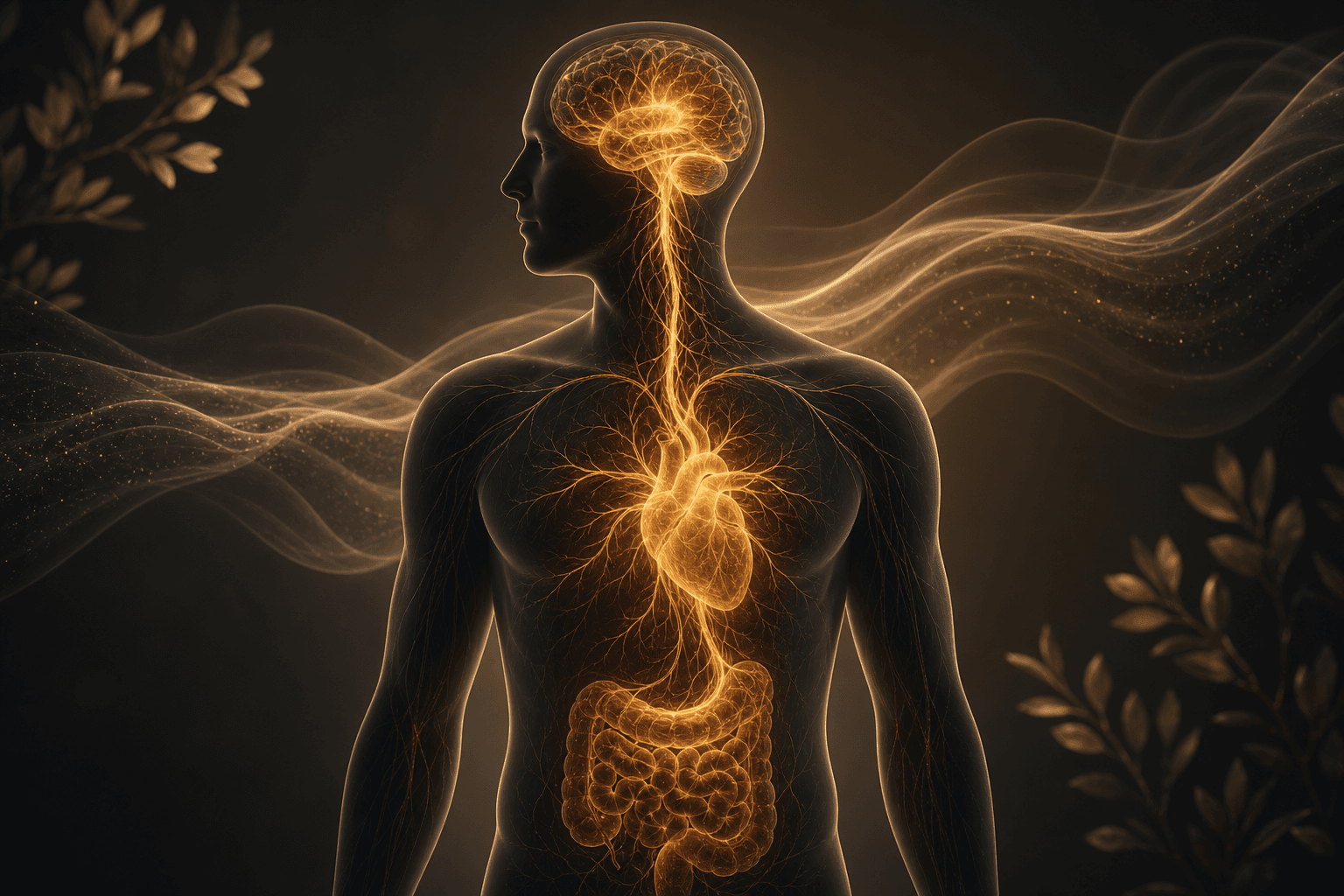
The vagus nerve helps connect the brain with the heart, lungs, gut, and other organs. It plays a central role in the parasympathetic nervous system, often described as the “rest and digest” branch.
When vagal tone is flexible, the body may be better able to shift between activation and recovery. This flexibility is often reflected in heart rate variability, or HRV, though HRV should be interpreted as a trend rather than a scorecard.
Supportive practices may include:
- slow diaphragmatic breathing
- longer exhales
- humming, singing, or chanting
- gentle movement
- restorative yoga
- time in nature
- safe social connection
- meditation, prayer, or contemplative practice
- laughter
- cold exposure when appropriate and well tolerated
The key is not intensity. It is safety and consistency.
Breathing is the fastest lever
Breathing is both automatic and voluntary, which makes it a bridge between the conscious mind and the autonomic nervous system.
A simple starting practice:
- Sit comfortably or lie down.
- Place one hand on the lower ribs or belly.
- Inhale through the nose for about four seconds.
- Exhale slowly for about six seconds.
- Repeat for two to five minutes.
The exact count matters less than the pattern: slow, steady, relaxed, and slightly longer on the exhale.
If a breath practice makes you dizzy, panicky, numb, or uncomfortable, stop and return to normal breathing. Not every method is right for every body.
Meditation and NSDR: training the downshift
Meditation is not an attempt to empty the mind. A more useful definition is practice in noticing and returning.
You sit. You notice the breath, body, sound, or a chosen anchor. The mind wanders. You return. That return is the practice.
For people who find seated meditation difficult, non-sleep deep rest, or NSDR, can be a more accessible entry point. These guided practices often involve lying down while attention moves through the body and breath. Yoga Nidra is one well-known form.
The goal is not to force calm. It is to practice creating conditions where calm is more likely to emerge.
Sleep is the master recovery signal
Sleep supports immune function, hormone regulation, memory processing, brain waste clearance, tissue repair, glucose metabolism, and emotional integration. Poor sleep can make stress feel louder the next day. Stress can make sleep harder.
Breaking the loop starts with rhythm:
- keep a consistent wake time
- get outdoor light early
- reduce bright light and screens at night
- avoid heavy meals and alcohol close to bed
- keep the room cool, dark, and quiet
- create a short wind-down ritual
If someone sleeps enough hours and still wakes unrefreshed, it may be worth exploring sleep apnea, pain, alcohol, medications, blood sugar changes, or circadian disruption with a qualified clinician.
The seven types of rest
One reason people remain tired after sleeping is that sleep is only one type of rest.
You may need physical rest after exertion, mental rest from constant decisions, emotional rest from performing or people-pleasing, social rest from draining dynamics, sensory rest from screens and noise, creative rest from constant output, or spiritual rest from disconnection from meaning.
A better question than “did I sleep?” is: what kind of tired am I?
The answer may point toward a different intervention: a walk, a boundary, a quiet room, a conversation, therapy, prayer, music, nature, or a day without extra input.
Social and emotional load are biological too
Not all stress comes from deadlines. Some of the deepest stress comes from relationships, grief, uncertainty, loneliness, caregiving, conflict, financial pressure, or the effort of holding everything together.
The body does not separate “emotional” stress from “real” stress. If the nervous system perceives threat, disconnection, or overwhelm, it responds.
Safe connection can be regulating. Being seen, heard, and supported can shift physiology. So can laughter, touch, shared meals, and honest conversation.
This is why social health belongs in a longevity plan.
A simple reset menu
In 60 seconds:
- exhale fully three times
- drop your shoulders
- unclench your jaw
- soften your gaze
- hum quietly on the exhale
In five minutes:
- step outside for daylight
- take a short walk
- practice slow breathing
- write down the looping thought
- sit without your phone
In 10 to 20 minutes:
- follow a guided NSDR practice
- take a restorative yoga break
- call someone safe
- prepare a nourishing meal
- lie down with legs elevated
Caveats and when to seek support
Stress-supportive practices are generally low-risk, but they are not a replacement for medical care or mental health care.
Seek professional support for persistent anxiety, panic, depression, hopelessness, thoughts of self-harm, severe insomnia, trauma symptoms, chest pain, fainting, unexplained shortness of breath, major appetite or weight changes, or stress that interferes with daily functioning.
Cold exposure is not appropriate for everyone, especially people with certain cardiovascular conditions, Raynaud’s, pregnancy considerations, or a history of fainting. Do not perform carotid sinus massage unless specifically instructed by a qualified clinician. Supplements can interact with medications and should be considered with appropriate guidance.
The TML lens
At The Maximum Life, we do not view stress regulation as another wellness chore. We view it as a core longevity practice.
Not because calm is morally superior. Because the body repairs in states of safety.
Decode the stress pattern. Design small recovery signals. Do them consistently. Deepen with better sleep, boundaries, relationships, clinical support, and data when needed.
Final takeaway
Stress is a biological signal moving through breath, heart, gut, hormones, sleep, and relationships.
You do not need to eliminate stress to live well. You need enough recovery to meet stress, metabolize it, and return to yourself.
The body is always listening. Give it more signals of safety.