At a glance
- Senescent cells are not just markers of aging; in some settings, they actively contribute to tissue dysfunction.
- Genetic clearance of senescent cells in mice helped establish causality, not just correlation.
- Senolytic drugs emerged from the idea that senescent cells rely on specific survival pathways to resist apoptosis.
- Different senescent cell types use different survival circuits, so there is no single universal senolytic.
- Early human studies show tissue-level target engagement and feasibility in selected diseases.
- Randomized data remain early, mixed, and highly dependent on context.
- Senolytics are promising frontier medicine, not general-purpose longevity supplements.
First, what are senescent cells?
Before talking about senolytics, it helps to define the cells they are designed to target.
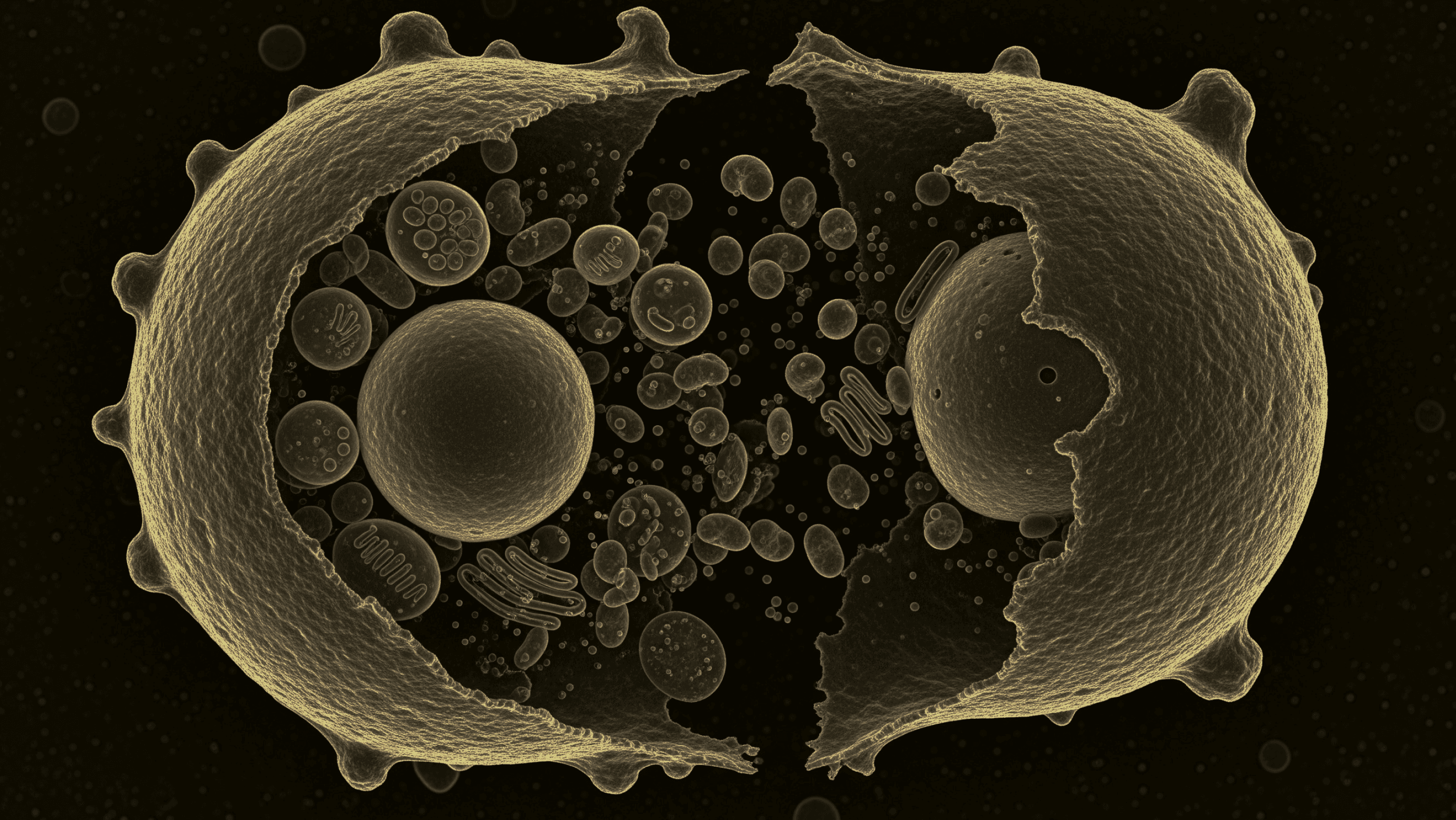
Senescent cells are cells that have entered a stress-response state. They usually stop dividing, but they do not simply disappear. They remain biologically active and can send signals into the tissues around them.
In the right context, this process is useful. Senescence can help stop damaged cells from becoming cancerous, support wound repair, and give the immune system a chance to clear cells that should no longer be active.
The problem is what can happen over time. As we age, senescent cells may accumulate faster than the body can remove them. When they persist, they can release inflammatory and tissue-remodeling signals that may affect nearby cells, change the local tissue environment, and contribute to dysfunction.
This is why researchers sometimes call them “zombie cells.” The phrase is imperfect, but the idea is simple: these cells are no longer functioning like healthy cells, yet they are still active enough to influence the body around them.
Senolytics are therapies being studied because they may help selectively clear certain senescent cells in specific contexts. That promise is scientifically important. It is also why the field requires restraint, physician-led interpretation, and careful human evidence before it becomes clinical guidance.
Bottom line
Senolytics have crossed an important threshold: they are no longer only an elegant biological idea or a mouse-lifespan story.
The field now has causal animal evidence, human tissue target-engagement data, disease-specific feasibility trials, and early randomized signals suggesting that response may depend on baseline senescent-cell burden.
That is meaningful progress.
It is not, however, a green light for consumer self-experimentation.
Why senescent cells matter
Cellular senescence is a stress-response state. Cells can become senescent after DNA damage, oncogenic signaling, mitochondrial stress, telomere dysfunction, inflammation, or other insults. Once senescent, they typically stop dividing, but remain metabolically active.
That matters because senescent cells can secrete a mixture of inflammatory and tissue-remodeling signals, including cytokines, chemokines, growth factors, and matrix-degrading enzymes. This SASP can affect nearby cells, recruit immune cells, alter tissue architecture, and potentially spread senescence-like states through paracrine signaling.
In youth, senescence can be useful. It helps suppress cancer by preventing damaged cells from proliferating. It participates in wound repair and developmental remodeling. The immune system also helps clear senescent cells.
With age, however, senescent cells may accumulate faster than they are cleared. Their signaling can become chronic rather than temporary. In that setting, senescence shifts from a protective program to a potential contributor to tissue dysfunction.
This is the conceptual basis for senolytics: if persistent senescent cells are helping drive pathology, then selectively removing enough of them might improve function.
The key phrase is “enough of them.” Senescent cells are heterogeneous. They differ by tissue, trigger, cell type, SASP profile, survival pathway, and disease context. That heterogeneity is not a footnote. It is central to the clinical future of the field.
Evidence
A major turning point came in 2011, when Baker and colleagues used the INK-ATTAC transgenic mouse model to inducibly eliminate p16Ink4a-positive senescent cells. In a progeroid mouse background, clearing these cells delayed several aging-associated disorders, including cataracts, sarcopenia, and adipose tissue dysfunction. Late-life clearance also slowed progression of already established pathology.
This experiment mattered because it moved senescent cells from correlation to causation. It suggested that senescent cells were participating in degeneration, not merely accumulating alongside it.
The next step was pharmacology. Researchers including Zhu, Tchkonia, Kirkland, and colleagues reasoned that senescent cells survive by relying on specific anti-apoptotic pathways. If those pathways could be identified, they might reveal vulnerabilities.
This led to early senolytic candidates such as dasatinib plus quercetin, and later navitoclax, which targets members of the BCL-2 family of anti-apoptotic proteins. The important point is not that these are magic longevity compounds. It is that senolytics emerged from a testable biological model.
That difference matters clinically. Dasatinib plus quercetin showed complementary selectivity across certain senescent cell populations. Navitoclax showed senolytic activity in some cell types, but its effects were not universal and its toxicity concerns are real, including platelet toxicity related to BCL-xL inhibition.
In 2018, Xu and colleagues showed that transplanting relatively small numbers of senescent cells into young mice could induce physical dysfunction and spread senescence to host tissues. In naturally aged mice, intermittent oral dasatinib plus quercetin improved physical function and increased remaining lifespan.
In the same year, Yousefzadeh and colleagues identified fisetin as a senotherapeutic in preclinical screens. In progeroid and naturally aged mice, acute or intermittent fisetin reduced senescence markers, improved tissue homeostasis, reduced age-related pathology, and extended median and maximum lifespan when given late in life.
These findings made senolytics one of the more compelling preclinical longevity categories. But mouse lifespan data are not human clinical guidance. Translation requires target engagement, safety, and disease-specific benefit in people.
Human translation
In 2019, Hickson and colleagues reported an open-label Phase 1 pilot in nine participants with diabetic kidney disease. Participants received dasatinib plus quercetin for three days. Eleven days later, adipose tissue showed reductions in senescence-associated markers and circulating SASP factors.
This was a real milestone: brief exposure to short-half-life agents produced measurable senescence-associated changes in human tissue.
But it was not proof of broad clinical benefit. It was target engagement.
Idiopathic pulmonary fibrosis has also been an important disease context because it is strongly linked to aging biology and senescent-cell accumulation. Early open-label and pilot randomized studies suggest feasibility and tolerability, with some functional signals but no definitive efficacy claim.
The brain is now on the map too. In a small Phase 1 feasibility trial in mild Alzheimer’s disease, dasatinib plus quercetin showed central nervous system penetration and was tolerated in a very small cohort. Cognitive and imaging endpoints did not change, which is not surprising given the design. The significance was mechanistic rather than therapeutic.
One of the most interesting recent signals is stratification. A 2024 Phase 2 randomized controlled trial of intermittent dasatinib plus quercetin in postmenopausal women was negative on its primary endpoint in the overall cohort. But women with higher baseline T-cell p16 expression, a proxy for higher senescent-cell burden, appeared more likely to show favorable bone-related responses.
This may be the clinical future of senolytics: not broad anti-aging use, but biomarker-informed use in selected patients.
Clinical nuance
Senolytics are often described in simplified language: “zombie cell clearing.” The phrase is memorable, but it hides the hard parts.
Senescent cells are diverse. Some are harmful. Some may be adaptive. Some may be involved in repair. Some may be irrelevant bystanders. Removing the wrong cells, at the wrong time, in the wrong tissue, or in the wrong patient could plausibly cause harm.
Several clinical nuances matter:
- Senescence is not one thing.
- Senolytics are not universal.
- Intermittent dosing may be central.
- Disease context matters.
- Biomarkers are still evolving.
- Toxicity is real.
- Target engagement is not the same as clinical efficacy.
For physicians and patients, the core question is shifting from “Can senolytics clear senescent cells?” to “Which patients, with which disease biology, have enough senescent-cell burden in the right tissue to justify the risk of intervention?”
That is a much more mature question.
What this does not mean
This does not mean people should start taking dasatinib, quercetin, fisetin, navitoclax, or other senolytic regimens on their own.
It does not mean senolytics are proven to extend human lifespan.
It does not mean a supplement stack that moved markers in mice will rejuvenate human tissues.
It does not mean more frequent dosing is better.
It does not mean senescent cells should be chronically suppressed or indiscriminately removed.
It does not mean that “natural” compounds are automatically safe at experimental doses.
The current evidence supports senolytics as a serious translational frontier — not as a consumer protocol.
The TML perspective
At The Maximum Life, we see senolytics as one of the most important areas in longevity medicine because the logic is unusually direct.
Senescent cells can contribute to tissue dysfunction. Removing them can improve aging-related phenotypes in animals. Early human studies show that brief treatment can change senescence-associated biology in tissue. Feasibility trials suggest intermittent regimens can be studied in older adults with age-related disease. Randomized data now suggest baseline senescent-cell burden may help identify responders.
That is a meaningful arc: mechanism, causality, pharmacology, target engagement, feasibility, and early stratification.
But the same evidence argues against hype.
The future of senolytics is unlikely to be a generic “anti-aging cleanse.” It is more likely to look like precision medicine: identifying a clinical phenotype, measuring relevant burden or pathway activity, selecting the right agent and schedule, monitoring toxicity, and tracking organ-specific outcomes.
Senolytics deserve attention. They also deserve restraint.
Practical takeaways
- Senolytics are promising, but early.
- Human evidence is strongest for target engagement and feasibility, not lifespan extension.
- The best current question is not “Do senolytics work?” but “Who might benefit, in which tissue, with which biomarker, and at what risk?”
- Baseline senescent-cell burden may be important.
- Do not self-prescribe dasatinib.
- Do not assume quercetin or fisetin are harmless at experimental doses.
- Avoid DIY navitoclax.
- Clinical review is essential.
- Lifestyle foundations still matter.
References
- Baker DJ, Wijshake T, Tchkonia T, et al. Clearance of p16Ink4a-positive senescent cells delays ageing-associated disorders. Nature. 2011.
- Zhu Y, Tchkonia T, Pirtskhalava T, et al. The Achilles’ heel of senescent cells: from transcriptome to senolytic drugs. Aging Cell. 2015.
- Zhu Y, Tchkonia T, Fuhrmann-Stroissnigg H, et al. Identification of navitoclax as a senolytic agent. Aging Cell. 2016.
- Xu M, Pirtskhalava T, Farr JN, et al. Senolytics improve physical function and increase lifespan in old age. Nature Medicine. 2018.
- Yousefzadeh MJ, Zhu Y, McGowan SJ, et al. Fisetin is a senotherapeutic that extends health and lifespan. EBioMedicine. 2018.
- Hickson LJ, Langhi Prata LGP, Bobart SA, et al. Senolytics decrease senescent cells in humans. EBioMedicine. 2019.
- Justice JN, Nambiar AM, Tchkonia T, et al. Senolytics in idiopathic pulmonary fibrosis. EBioMedicine. 2019.
- Nambiar AM, Kellogg DL 3rd, Justice JN, et al. Dasatinib and quercetin in idiopathic pulmonary fibrosis. EBioMedicine. 2023.
- Gonzales MM, Garbarino VR, Kautz TF, et al. Senolytic therapy in mild Alzheimer’s disease. Nature Medicine. 2023.
- Farr JN, Atkinson EJ, Achenbach SJ, et al. Effects of intermittent senolytic therapy on bone metabolism in postmenopausal women. Nature Medicine. 2024.
This article is for educational purposes only and does not constitute medical advice, diagnosis, or treatment. Senolytic therapies remain an emerging area of clinical research. Do not start, stop, or combine dasatinib, quercetin, fisetin, navitoclax, or any other senolytic regimen without medical supervision.